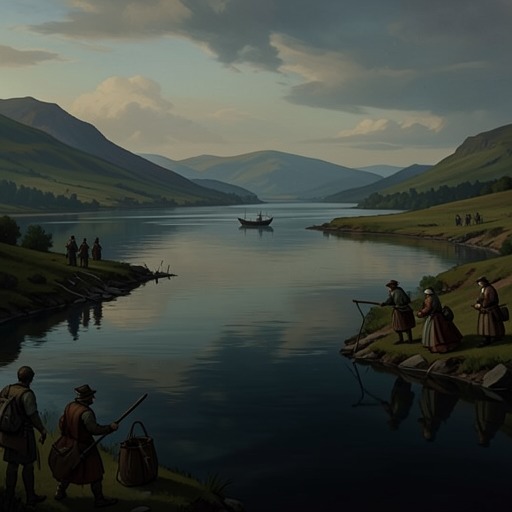
Baztán Valley
Ofrenda a la tormentaBaztán Valley is the landscape in which the novel’s secret groups, infant deaths, and river-linked investigations converge. Its significance is not simply that crimes happen there: women born in the valley become victims elsewhere and are brought back as offerings, while a separate pattern of infant deaths follows the course of the Baztán River and its continuation as the Bidasoa. The river turns the setting into an investigative instrument, tracing a geography of violence that the characters must distinguish from coincidence, rumor, and ritual belief.
The valley as a geographic pattern
Amaia Salazar’s reconstruction begins with a map of addresses linked to babies who died in their cribs. Jonan Etxaide had added Amaia’s own twin sister to the file, but removed the children of Yolanda Berrueta. At first, Amaia marks the deaths and considers whether their arrangement might reflect a major road used to escape. It does not. When she makes a fresh map and excludes the Ainhoa children, the remaining points form a line that becomes unmistakable against the blue course of the river. The pattern runs from Erratzu through Elbete and Elizondo to Arraioz, and continues with Haizea Tremond Berrueta’s case as far as Oieregi.
That reading changes as the investigation widens. The officers compare deaths along the river with cases from further back in time, adding old incidents in Elizondo, the child associated with Argi Beltz, Amaia’s sister, the girl from Lesaka, the daughter of the lawyers Lejarreta y Andía in Elbete, and the girl whose father confronted the forensic doctor in Erratzu. The resulting line follows the river from its source to its mouth, through towns where it is called the Baztán or the Bidasoa. The map does not itself prove a common cause, but it gives the investigators a spatial pattern specific enough to guide further inquiry.
Records gathered through parish baptism registers extend that pattern across a larger area. In Hondarribia, four possible cases are reduced to two: one child was German and died while her parents were on holiday; the other had been baptized. Restricting the wider search to towns bordering the river, the investigators mark one case in Elizondo, one in Oronoz-Mugaire, one in Narbarte, two in Doneztebe, and two in Hondarribia. Further parish checks are slow because the relevant information is held by individual priests and can only be consulted in person. Even so, the plotted sequence now reaches the river’s mouth and the boundary with Guipúzcoa.
Infant deaths and the limits of proof
The mapped deaths acquire a more troubling profile when Amaia lays out what the families have in common. The victims were girls; their families were generally in difficult economic circumstances when the children died; and several families later experienced improved prosperity. In at least four cases, including those of Yolanda Berrueta and Esparza, family members had said at the time of the deaths that things would be better from then on. The juxtaposition raises a question for the investigation, but it is not presented as proof that financial change caused the deaths or that every family shared the same motive.
Yolanda’s history also shows the human cost concealed by a map’s clean marks. After the first baby died, she suffered severe depression. Her father said that her husband nearly forced her to become pregnant again despite medical advice against it. She endured the pregnancy badly, then devoted herself to the children after they were born, carrying guilt and bitterness. Yet the investigators could neither confirm their suspicions about the girl’s absence from her grave in Ainhoa nor obtain judicial permission to examine it again. The river pattern is therefore compelling but incomplete: in this part of the inquiry, geography gives the officers a line to follow, not the authority or evidence to settle every case.
Argi Beltz and the valley’s hidden history
The valley’s present pattern is set against the history of a secret group active in Lesaka and Baztán in the late 1970s and early 1980s. According to Amaia’s account of the investigation, Doctor Xabier Markina combined expensive treatments at his clinic in Las Rozas with leadership of the group. Its members treated him as a spiritual guide, and he introduced them to occult practices. A witness in custody identified Markina and reported seeing, and participating in, the human sacrifice of a newborn girl at a farmhouse in Lesaka. The same witness said that the group visited another circle at Argi Beltz in Baztán, where members were preparing an identical sacrifice, and identified Amaia’s mother as one of that group’s members.
The valley also figures in the investigation of Berasategui’s murders, though the victims’ lives did not remain within its boundaries. Amaia explains that the women selected by the Tarttalo were women of Baztán origin; most no longer lived in the valley, and some died hundreds of kilometres away. They nevertheless ended as offerings in a cave in the valley. Berasategui used his psychiatric work and knowledge of behavioral disorders to manipulate men into carrying out murders, but Amaia’s analysis shifts attention from the men he controlled to the women he chose. In her account, the perpetrators were actors in his design; the selection of victims and the later treatment of their bodies reveal the pattern behind it.
The cave and the river mark different forms of return. The women killed elsewhere are brought back to the valley as offerings, while the infant cases are read through a line of communities following the water. Amaia connects the image of the river to the command to clean it and to recurring dream images of empty coffins and enormous white flowers. These associations do not replace forensic proof, but they give the setting a ritual vocabulary through which buried deaths and the demand for purification become legible to her.
River, storm, and aftermath
The Baztán River is more than a line on the investigators’ map. After a storm, Amaia stops at Muniartea Bridge and watches the water, swollen by the rush from Erratzu, having swept along its banks toward Hondarribia. The river is now quiet beneath her, although its recent force has altered the landscape it passed through. At the bridge she touches the cold stone and wonders whether the river has been cleaned and the offense washed away. The question binds the investigation’s spatial pattern to its emotional aftermath: a landscape associated with violence is also imagined as capable of carrying something away.
The scene offers no simple declaration that the valley has been healed. Amaia returns home and weeps in Engrasi’s arms for fear, anger, bitterness, regret, death, and what has been violated. Her exhaustion and grief remain part of the aftermath even as she prepares herself for what she must do next. Baztán Valley thus holds the novel’s evidence and its unresolved emotional burden at once: the river can expose a pattern and serve as an image of cleansing, but neither map nor current can erase what has happened.